The Year of the Pitcher: Corralling Chaos in 1968
By the time the Cardinals and Tigers met for Game 1 of the 1968 World Series on October 2, two leading figures had been assassinated, riots had burned dozens of cities, Chicago police had clubbed protestors at the Democratic National Convention on live television, and Soviet tanks rolled through Prague. Inside the ballpark, Bob Gibson struck out 17 Detroit Tigers in a 4-0 shutout in one of the most controlled pitching performances in baseball history. With chaos reigning through most of the summer, baseball pitchers dominated batters like never before.
While baseball could not defeat the chaos of 1968, it could corral something inside its perimeter. For three hours at a time, inside ballparks, pitchers set the boundaries of what could happen. Gibson set perimeters so tight that the 1968 NL averaged a .243 batting average against him, and the bulk of his strikeouts came not from overpowering hitters but from making hitters chase pitches outside the space where contact was possible. The corral was the pitch sequence itself: fastball up, slider away, fastball in, slider away. Hitters worked the space Gibson permitted. Gibson chose what space to permit.
Where Gibson built corrals, Lolich defended them. Three complete games in eleven days, twenty-seven complete game innings on increasingly short rest. Lolich's corral didn't have the precision of Gibson's. His slider broke wider, his fastball ran more. However, Lolich held a perimeter in the World Series through sheer endurance and ended up out pitching the master.
The 1968 Detroit Tigers: Curse Breakers
The Tigers entered 1968 as the team that had collapsed in the 1967 final-week pennant race losing the AL pennant to Boston on the final day of the season in a 4-team scramble. That collapse was not just a loss, but a year-long reverberation that fed directly into 1968. Detroit had entered the season healing from the 1967 Detroit riots, one of the deadliest urban uprisings in American history. The Tigers winning the World Series in 1968 became part of the city's psychological recovery narrative.
The team went 103-59 and won the AL pennant by 12 games over Baltimore. The biggest AL pennant margin since the 1936 Yankees. The roster was a long-time group of Tigers that overcame key injuries mid-season to finally get over the hump into the World Series.
Denny McLain: RHP, 31-6, 1.96 ERA, 280K, 28CG. The last 30-game winner in Major League Baseball. AL MVP, AL Cy Young, Sports Illustrated Sportsman of the Year. Ego-drive, organ-playing, controversy-magnet 24-year old who peaked at the right the time. McLain's career trajectory implodes by 1972 (gambling, drug, weight, and finally federal racketeering issues), but in 1968 he was the most famous active pitcher in baseball.
Mickey Lolich: LHP, 17-9, 3.19 ERA. Overshadowed by McLain in the regular season but became the World Series hero. Lifetime workhorse and motorcycle enthusiast he pitched until 1979.
Al Kaline: RF, .287/.392/.428, 10 HR. Future first ballet HOF. Veteran face of the franchise for over a decade he missed the mid-season with a broken arm but returned for the stretch run. World Series hero in his lone appearance after 16 years.
Norm Cash: 1B, .263/.346/.487, 25 HR, 63 RBI. Lefty slugger who was the 8th Tiger to hit 30+ HR in a season multiple times. Beloved by his teammates he was known for pranks and being the team comedian.
Willie Horton: LF, .285/.352/.543, 36 HR, 85 RBI. A Black Detroit native, the riot-context cultural significance of Horton's 1968 season is enormous. He drove through the 1967 riot zone in uniform attempting to calm crowds. Horton overcame the Year of the Pitcher to put together one of the finest offensive displays of 1968 and the best of his career.
Bill Freehan: C, .263/.366/.395, 25 HR, 84 RBI, Gold Glove. AL MVP runner-up to McLain. 11-time All Star he was likely the underrated catcher of his era.
Mickey Stanley: CF .259/.297/.378 11 HR. Gold Glove defender who famously moved to play SS for the World Series when manager Mayo Smith felt he could not trust the regular SS bats in one of the greatest managerial gambits ever seen.
Eddie Mathews: 3B/PH .212/.337/.394, 3 HR. Future HOF in his final season played the crucial veteran presence especially with the injury to Kaline.
Mayo Smith: Manager. Second-year Tigers manager who defied expectations with a calm, under-stated managerial style. Smith's baseball lifer status helped foster a resilient, confident team that stood up under the pressure of 1968.
Detroit was a power-hitting team built around McLain's historic season and a deep middle of the line up. They broke the AL pennant chase open early and coasted to October. The cultural backdrop of post-riot Detroit gave the team unusual significance beyond pure baseball.
The 1968 St Louis Cardinals: Defending Champions"
The Cardinals entered 1968 as defending World Series champions having beat Boston in 7 games in 1967. The core was at its peak: Gibson at 32, Brock at 28, McCarver at 26. They'd been to consecutive World Series and were odds-on to make a third. The team went 97-65 to win the NL pennant by 9 games over the San Francisco Giants.
Bob Gibson: RHP, 22-9, 1.12 ERA, 268 K, 28 CG, 13 SHO. The lowest single-season ERA in the modern era (since 1920). Won NL MVP, NL Cy Young. At age 32 he was a future first ballet HOF at the apex of an already elite career. His 1968 season is the single greatest pitching performance of the live-ball era.
Lou Brock: LF, .279/.328/.418, 6 HR, 62 SB, 92 R. Another future first ballot HOF he had a stolen base record in his sights. Despite being known for his speed he hit 2 HRs and batted .464 across the 7 game series.
Curt Flood: CF, .301/.339/.366, 5 HR. A defensive virtuoso and future free-agency pioneer he famously misjudged Jim Northrup's line drive in the pivotal 7th game of the World Series.
Tim McCarver: C, .253/.310/.378, 5 HR. Future broadcasting icon he was the steady backstop for one of the greatest pitchers ever.
Orlando Cepeda: 1B, .248/.306/.378, 16 HR, 73 RBI. This future HOF was 1967 NL MVP the year before, but his 1968 season saw a sharp regression.
Roger Maris: RF, .255/.327/.374, 5 HR. Perennial winner, this represents his final season. Brought to STL from NYY in a 1967 trade his presence on the 1968 team is thematically significant.
Steve Carlton: LHP, 13-11 2.99 ERA. At age 23, this future HOF was beginning to develop the elite fastball/slider combination that would have him dominate into the 1980s.
Rod Schoendienst: manager. Dedicated ambassador of the St Louis Cardinals for over 70 years he was known as a patient manager who focused on fundamentals and team work. He would go into the HOF in 1989.
The defending champions ran back the same core that beat Boston in 1967. Less explosive than Detroit, but Gibson and Brock respective dominance and depth from a stable veteran roster had them pegged as heavy favorites entering the 1968 World Series.
The 1968 World Series: Lolich vs. Gibson
Entering the World Series, Gibson was riding the most dominant single-season pitching performance of the modern era. McLain was riding the most dominant win total since Dizzy Dean's 1934 season. The October matchup was framed as McLain vs. Gibson, but Lolich emerged as the actual pitching protagonist on the Tiger's side.
Game 1 (October 2, Busch Stadium): STL 4-0. Bob Gibson struck out 17 batters--the World Series single-game strikeout record. Brock hit a HR. McLain pitched poorly and the Tiger's offense managed just 5 hits. Gibson's dominance set the tone.
Game 2 (October 3, Busch Stadium): DET 8-1. Mickey Lolich got the win in his first World Series start. Willie Horton, Norm Cash and Lolich himself (career first home run is in the WS) all hit HRs.
Game 3 (October 5, Tiger Stadium): STL 7-3. Cepeda and McCarver provide the offensive highlights. Cardinals took the lead.
Game 4 (October 6, Tiger Stadium): STL 10-1. Bob Gibson complete game, 10K gem. Brock hits his second HR and the Cardinals looked like they were going to run away with the World Series.
Game 5 (October 7, Tiger Stadium): DET 5-3. The turning point of the series. Cardinals led 3-2 in the 5th with runners on first and second with no outs. Lou Brock attempted to score from second on a single, but Willie Horton's perfect throw nailed Brock at the plate. Brock chose to slide standing up rather than slide low, a crucial decision that allowed Freehan to tag him out. The Cardinals never recovered and the Tigers scored 3 in the 7th with a bases loaded single by Al Kaline driving in the go-ahead runs. Lolich got the win, his second of the series.
Game 6 (October 9, Busch Stadium): DET 13-1 Jim Northrup hit a grand slam in a 10-run third inning. McLain finally got his first World Series win and the Tigers forced a Game 7 in St Louis.
Game 7 (October 10, Busch Stadium): DET 4-1 Lolich pitched on two days rest against Gibson. The two teams were scoreless through six innings before Curt Flood misjudged a deep fly ball by Jim Northrup. The ball ended up over his head for a 2-RBI triple. Freehan's double drove in another run and Lolich went the distance for his third complete game win of the series.
Lolich went 3-0, 1.67 ERA with 3 complete games, on short rest in Game 7 for the WS MVP. Easily one of the greatest single-series pitching performances ever with a workload that has gone long extinct in contemporary baseball.
Historical Significance
This was the end of the high-mound, pitcher dominated 1960s. The 1968 season had a .230 league batting average, McLain's 31 wins, Gibson's 1.12 ERA and Carl Yaztrzemski's .301 winning the AL batting title. Baseball's response was to lower the pitcher's mound from 15 inches to 10 inches and shrink the strike zone. The rule changes came directly from 1968's offensive collapse. The 1968 World Series is the pivot point between two distinct baseball eras.
Curt Flood's misplay didn't just lose the World Series, it haunted Flood. After the 1969 season the Cardinals traded Flood to Philadelphia in a multi-player deal. Flood famously refused to report and sued MLB, challenging the reserve clause and launching the legal path that led to free agency in 1975.
McLain in 1968 was the last MLB pitcher to win 30+ games. With 5-man rotations, pitch counts, lower mound, and bullpens taking over high-leverage innings, this is now considered an unbreakable record. No pitcher has won 25+ games since Bob Welch's 27 wins in 1990. The 30-win season is functionally extinct.
Gibson's 1.12 ERA stands as the lowest single-season ERA in modern baseball history. Pedro Martinezs's 1.74 in 2000, in a different offensive context arguably more impressive, is the closest challenger. Gibson's record is considered unbreakable in the current offensive environment.
Detroit's championship came 14 months after the riots of July 1967. The team's success, particularly Horton's prominence, was incorporated into the city's recovery narrative. Detroit-born Black star Horton in the championship outfield at the moment of civic healing is part of the World Series has weight beyond the on-field events.
The 1968 loss closed the Cardinal's 1964/1967/1968 three-pennant cycle. The Cardinals would not return to the postseason until 1982, a 14-year drought.
The 1968 Detroit Tigers ball I have has 29 signatures, basically the complete 1968 Tigers roster. Notable signatures include Al Kaline, Norm Cash, Mayo Smith, Bill Freehan, Denny McLain, Willie Horton, Mickey Lolich, Jim Northrup and Mickey Stanley. Eddie Matthews is not present.
While the Tigers won the series, the 1968 St Louis Cardinals ball is the bigger gem. This is the apex Cardinals piece, with 24 signatures and in nearly mint condition. It has five HOFs: Schoendienst, Cepeda, Carlton, Gibson and Brock. It has Roger Maris in his final season. It has both Curt Flood and Tim McCarver as key signatories.
Schoendienst and Cepeda share the sweet spot as manager and 1967 NL MVP.
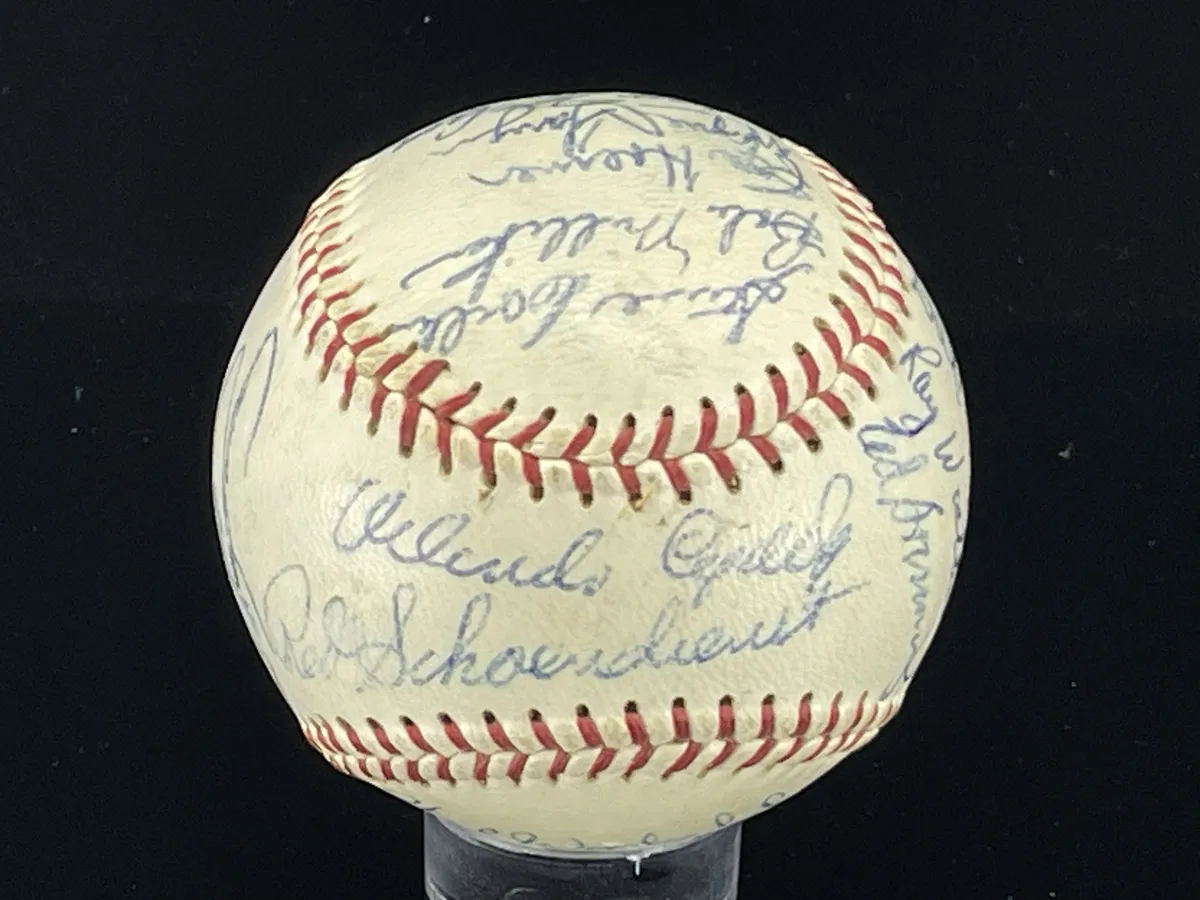
The most "fun" panel showcases a young Steve Carlton at the top and his backstop Tim McCarver and legendary Roger Maris toward the bottom.
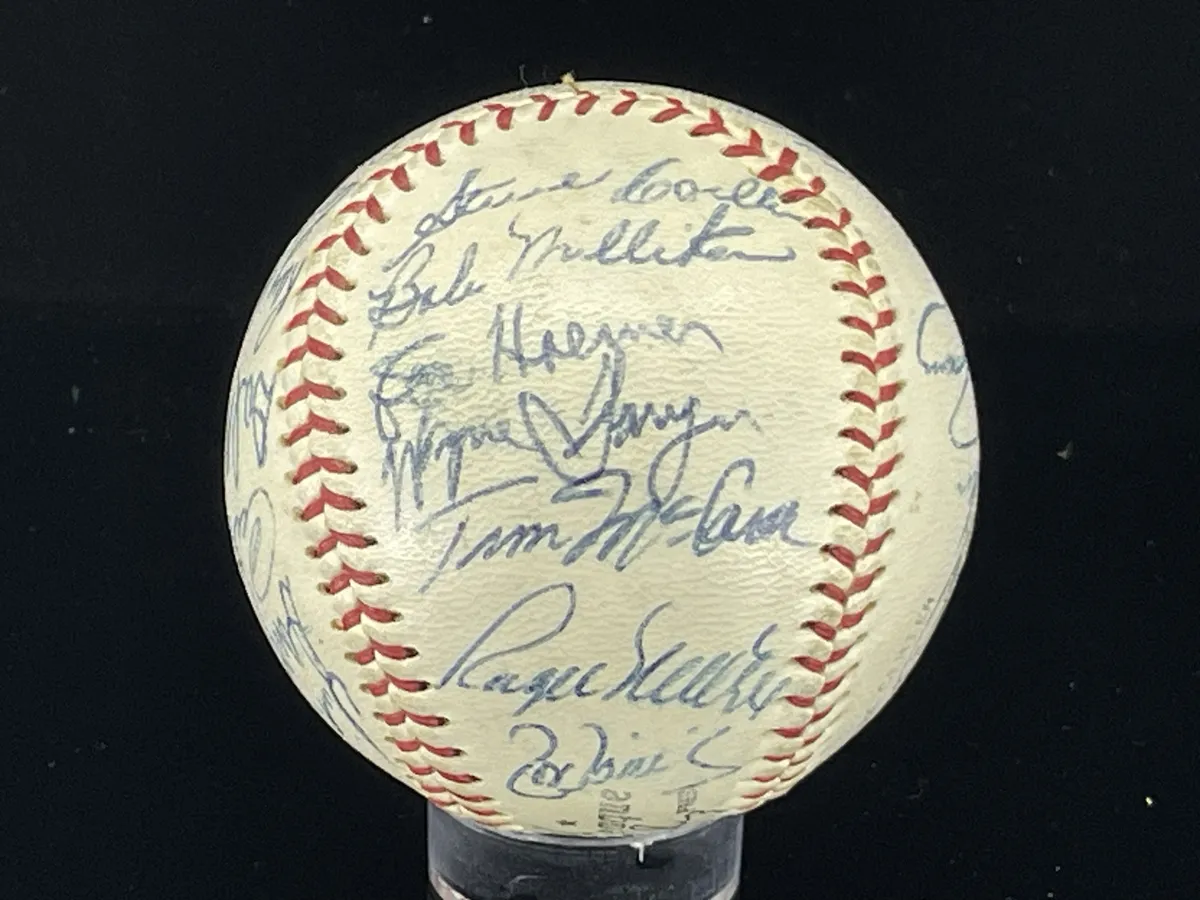
Of course, it would not be a 1968 Cardinals ball without Bob Gibson.
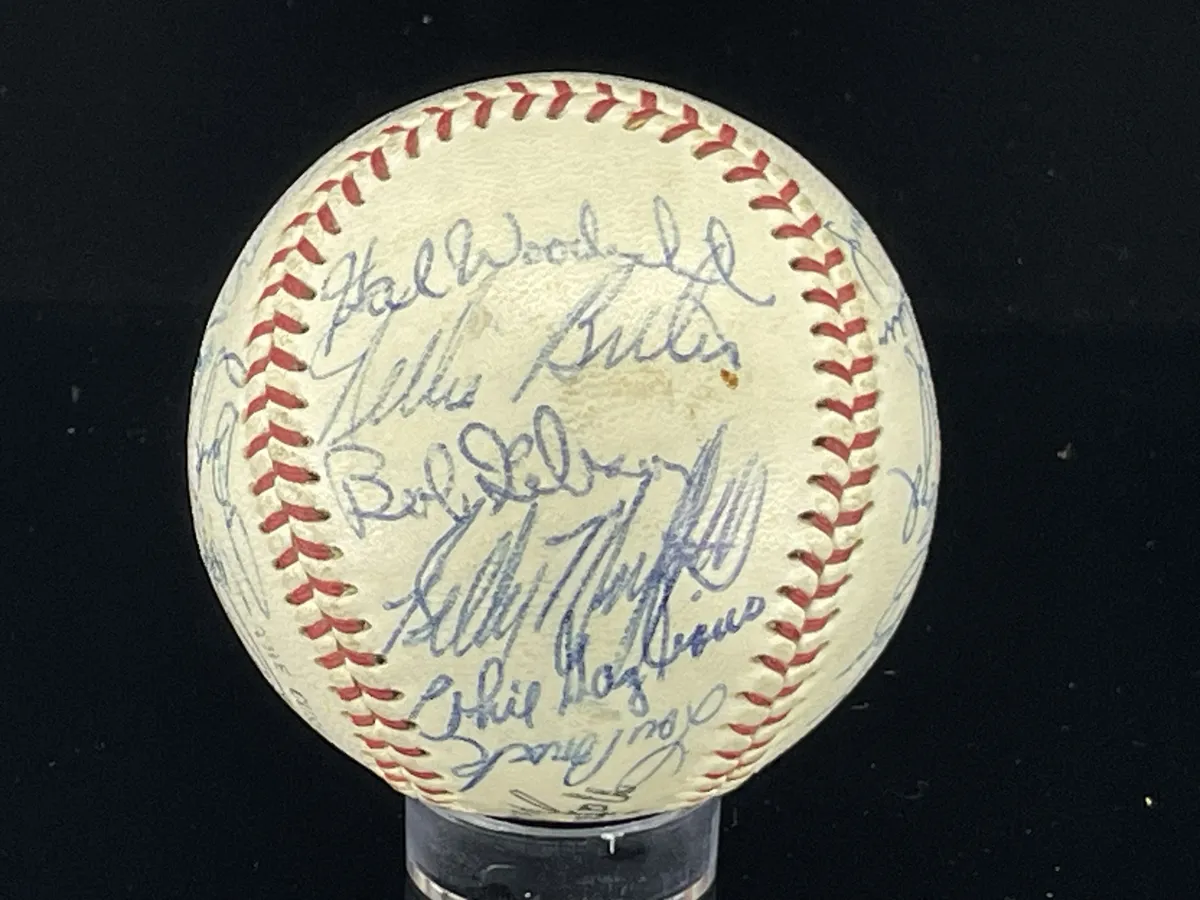
The pair has an unusual feature, the NL loser is structurally stronger than the AL winner. In most combatant pairs, the winner has the historical narrative weight (Mantle 1952, Carter 1993, Mazeroski 1960) and the loser is the supporting cast. The 1968 pair inverts that. Detroit won the series, but St Louis sits higher in both value and aesthetics here.