The Exterior Narrative
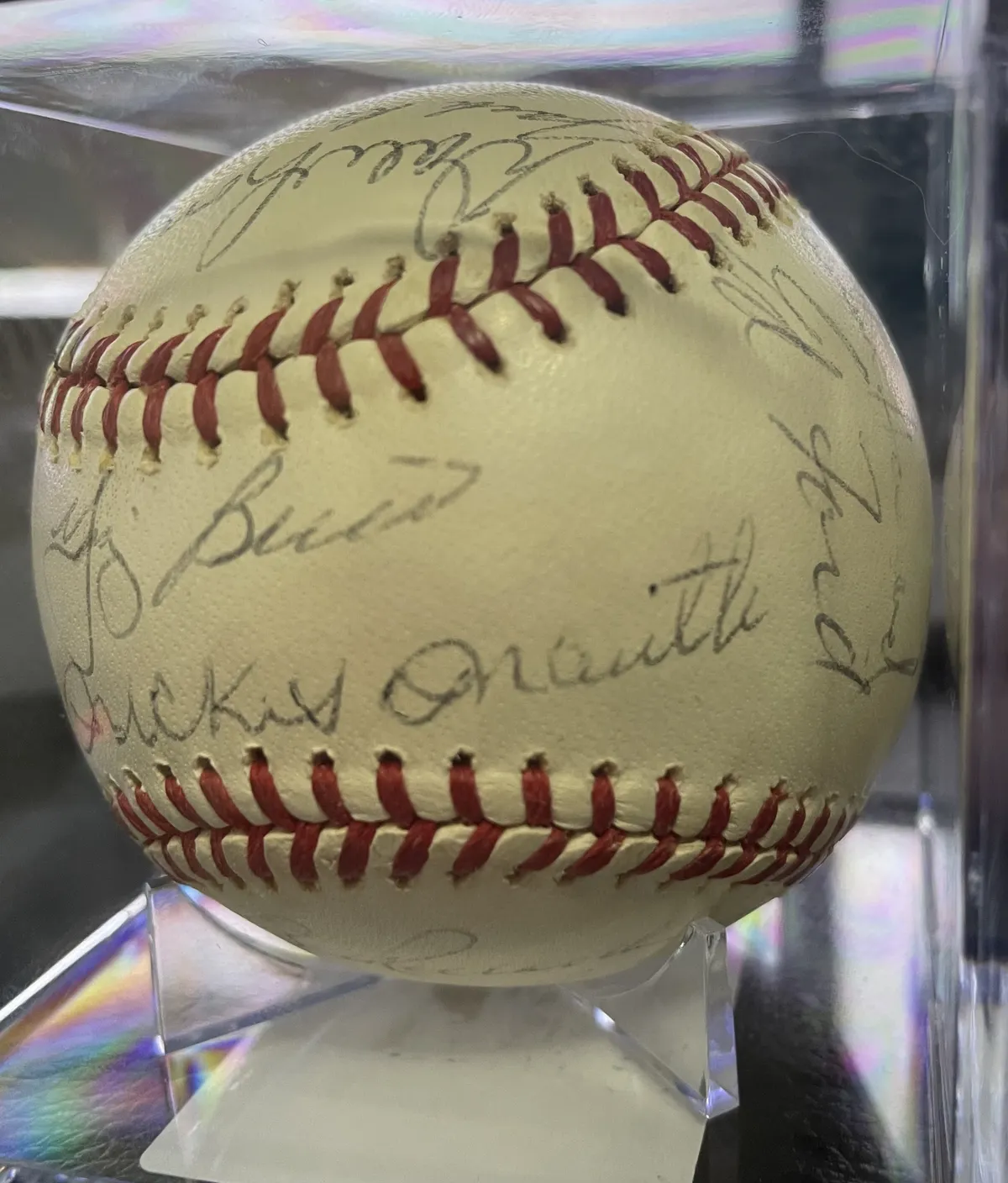
I have a strong interest in the year 1962 through the lens of baseball history. As a result, the prospect of picking up a clean 1962 Yankees team signed ball was something of particular excitement. I have procured autographed baseballs through auctions and from eBay, but the provenance of this specific 1962 candidate was uniquely compelling.
If the Skeptic and the Empiricist represent the law, then the Archivist represents history. In the world of collecting this is called "provenance"-the documented chain of custody that links the object to its origin. For many, provenance provides the exterior narrative that connects the present to the past. Our desires may give us the interior story, but provenance helps solidify that outside ourselves.
The provenance for this ball was, by all accounts, impeccable. This was not a relic found in a random attic or cycled through a pawn shop. The seller claimed his uncle was a Bronx native who played for the Chicago White Sox. On Old Timers Day in 1962, he played against the Yankees in the Bronx, and it was on this day he allegedly secured the team's autographs.
I decided to do some research. I was able to confirm the player described existed. The seller had a bunch of minor league baseballs from the era to sell as well and pointed to a notarized letter from his aunt attesting to the ball's origin. This provenance reframed the ball as a gift exchanged between peers on the hallowed grass of Yankee Stadium. I held quiet hope that the Mantle, Maris, Berra, Ford and Houk would emerge from the forensic process as "legit." After all, if a Titan would not sign a ball for a fellow player on the diamond, who would he sign for?
Alas, forensic memory is indifferent to the stories we tell ourselves. The narrative I constructed...fragments of which were borrowed from a stranger and wrapped together with probabilities...met the inevitable clash of stochastics and determinism. The verdict from JSA: the ball was a beautiful piece that had weathered time well, but the Mantle was a "clubhouse." Even in the presence of his peers, the myth had been delegated to an understudy.
The Portfolio of Truth
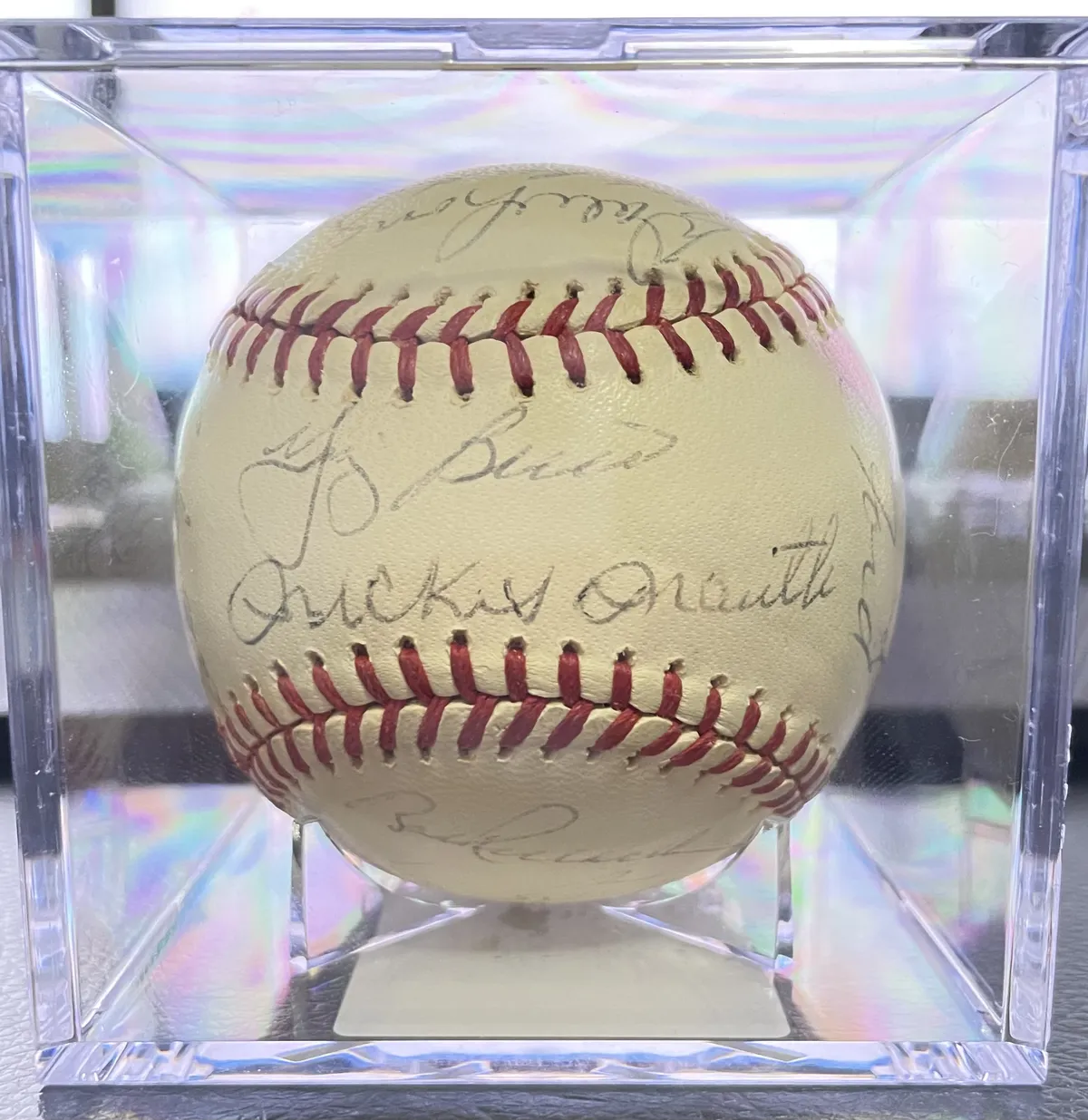
The sting of this "failure" is mitigated by the realization that all the other twenty-two signatures passed the test. Roger Maris, a Titan as much as Mantle was in the early 1960s, sits cleanly on a side panel. Yogi Berra shares the sweet spot with the ghost of Mantle. Fellow Hall of Famer Whitey Ford is present and accounted for.
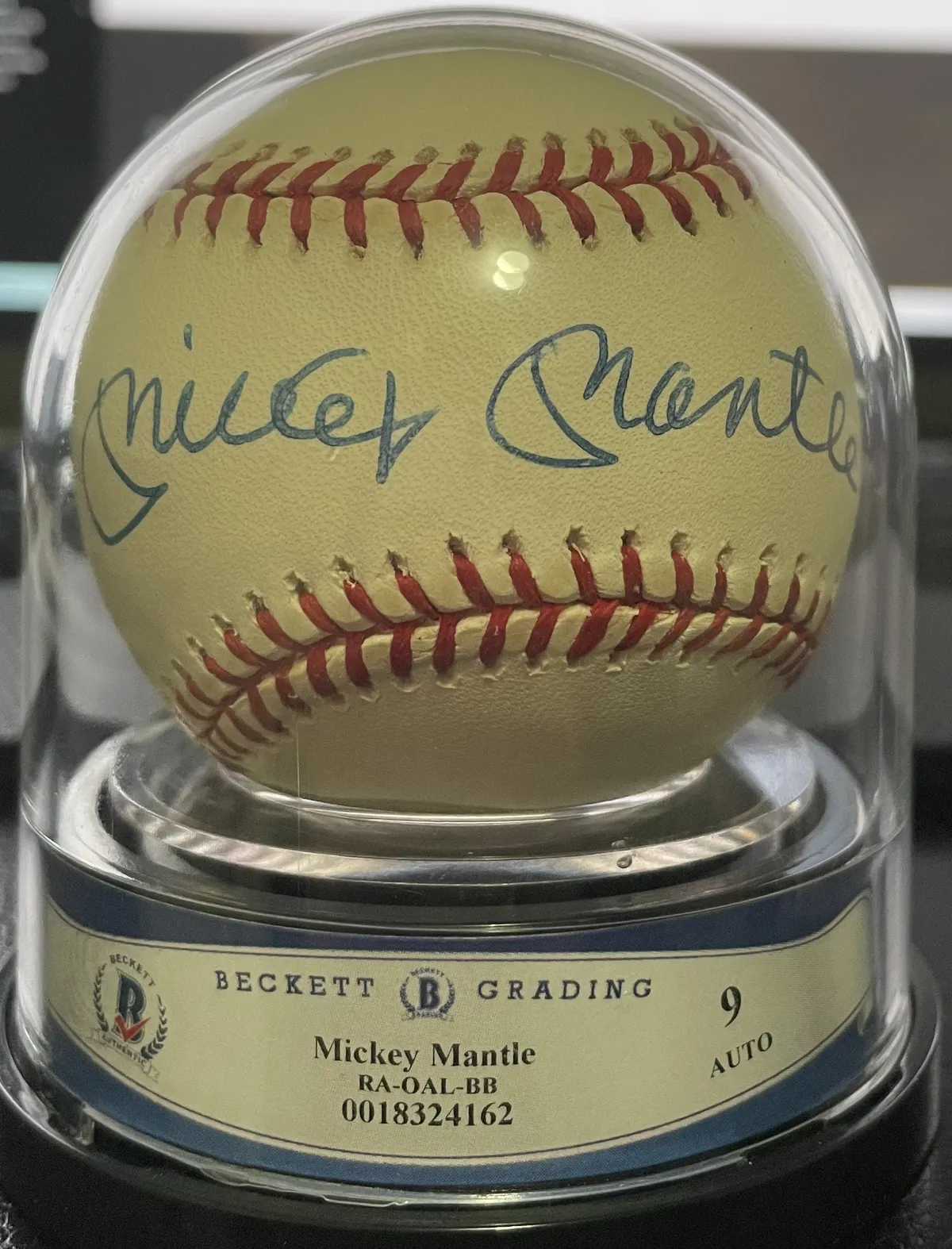
I look at my team signed balls from 1955, 1956 and 1960, or my individual Mantle autographed ball, "slabbed" and graded a "9" by Beckett. In these specimens, the forensic and the memory align. These "Absolute Truths" in the display case changes how I feel about '62 ball. I've come to appreciate the clubhouse signature aesthetically; it is a clean, practiced representation that provides visual harmony. It exists now as a mix of aesthetic choice and a historical record of the sheer demand to touch Mickey Mantle.
Furthermore, by choosing JSA, I consciously invited the Skeptic into the room. I demanded a level of rigor knowing full well that JSA operated on a higher standard of doubt. Sometimes my mind wanders toward a different epistemological answer, and I contemplate a pivot to the Empiricists (PSA or Beckett) to see if their measure of probability offers a different take. The judgment is an opinion, not a fact here.
The Anatomy of a Ghost
I find myself looking at the other Mantle signatures. Comparing the 1962 clubhouse Mantle to my 1955 Yankees team signed ball offers a study in symmetry-Berra and Mantle sharing the sweet spot on both. However, the ink quality of the '55 ball is elusive. I see the similarities in Berra's hand, but the Mantle is hard to "feel."
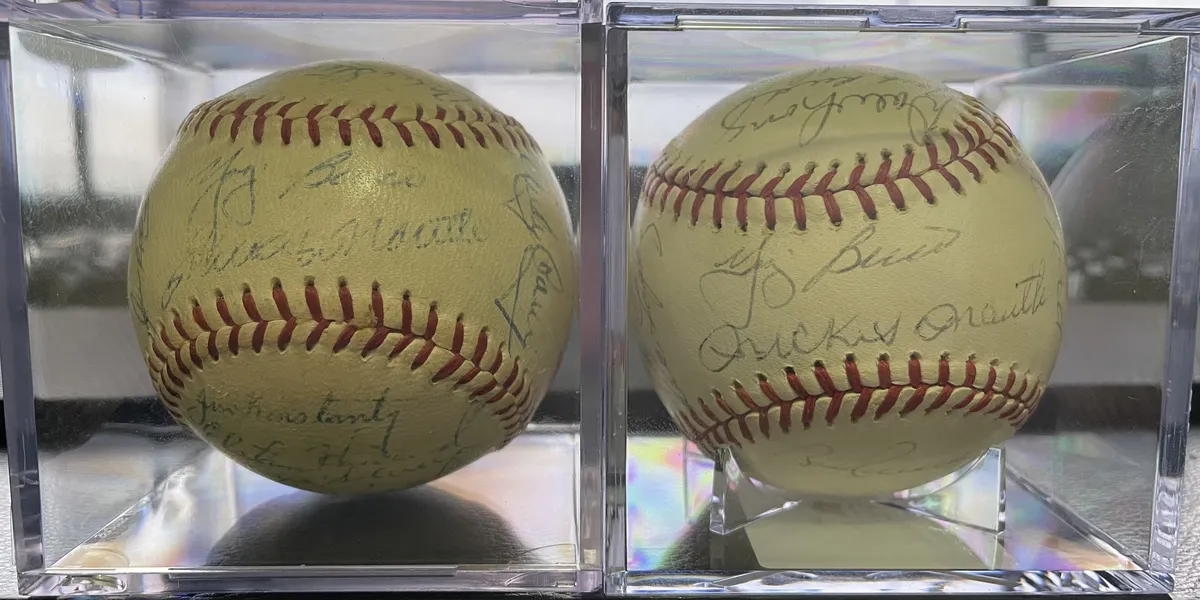
I go and fetch my trusty 1960 Yankees team signed ball. Closer in time to '62, the Mantle signature is distinct and holds the sweet spot in its entirety. Staring at the two side by side, my eyes leap to the 'k' in Mickey. The 1962 signature has a 'k' that looks...too much like a 'k.' Then I see the tightness-the smallness-of that 1960 signature. While prominent, it lacks the bravado and confidence that my 1962 Mantle has.
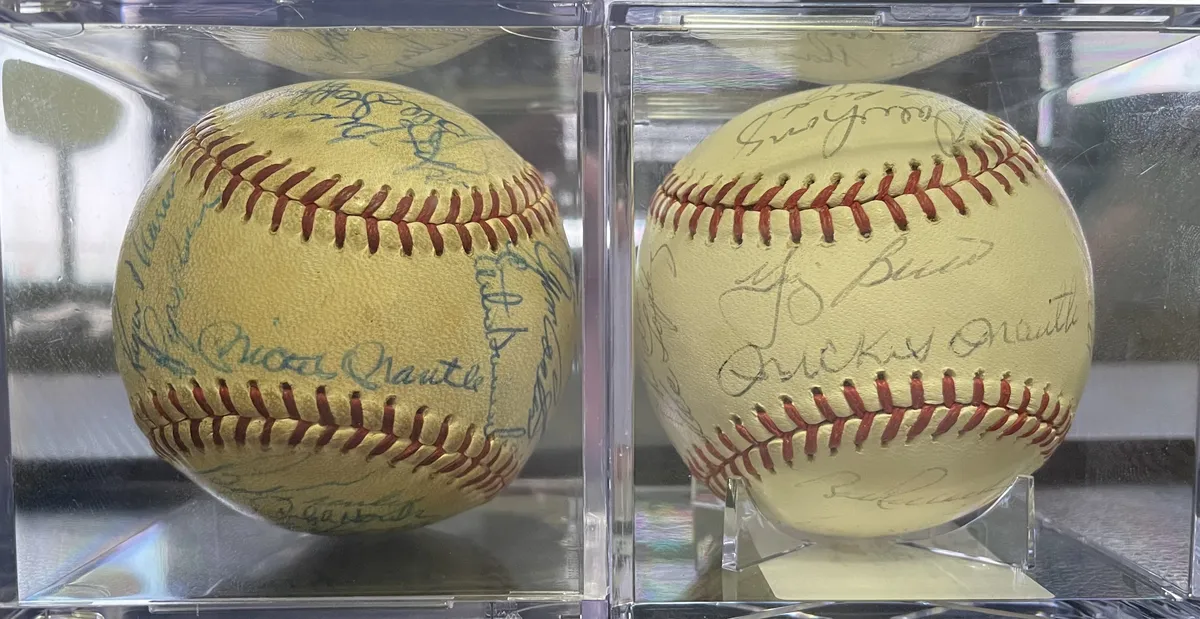
Finally, I reach for my most pristine example: a Beckett encapsulated autograph graded 9 out of 10. Side-by-side with the '62 ball, the discrepancies become undeniable. I notice the 'k' in Mickey but also the crossing of the 't' in Mantle. On the 1962 ball, the dash at the top of the 't' in the 1962 ball invades the 'l' next to it. In the clean, thick blue signature of the Beckett encapsulated ball there is no such confrontation. I scurried back to review the 1955 and 1960 examples and saw that they came closer to the clean delineation on the Beckett ball.
This is the likely forensic reality. This is what the clubhouse boy, despite years of practice, failed to nail
The Synthesis of the Shelf
This leaves me with a final reflection: Do I truly need a "real" Mantle on every Yankee team ball of the era to satisfy my desire?
On the 1962 ball, the "Noble Lie" preserves the completeness of the team. It allows the ball to look the way history should look. While I would prefer the Titan's own hand with greater certainty, the "portfolio effect" of my collection provides a practical peace of mind. I have the god in one frame and his shadow in another. Ultimately, I find that I value these relics for vastly different reasons, and their proximity to one another on the shelf creates a dialogue that a single "perfect" ball could never sustain.
The 1955 ball may suffer from a lower ink quality, but its authenticity is not in doubt. Because the Yankees lost to the Dodgers in the World Series that year, there is a poetry in the ball's weathered appearance; the "essence" of that hard-fought season is stronger and is reflected in a lack of polish.
My 1960 ball is a different story. While the Mantle signature sits alone on the sweet spot feeling almost out of place compared to the iconic Berra/Mantle pairing on the '62, it is undeniably the Titan's own hand. Roger Maris can be found looking on from a side panel along the seam, serving as a harbinger of the 1961 season-a snapshot of the M&M boys on the precipice of their historic tear.
Perhaps the clubhouse signature is not a void, but a bridge. It reminds me that I was not at Old Timers Day in 1962. I never stood in old Yankee Stadium, pen in hand, waiting for a god to descend. So what is it that I am "further" from? Is it the memory of a stranger? The essence of the ballpark? A specific time that I could never actually be in? Or is it simply the human craving for the absolute--the quiet, driving madness of knowing that while the rest of the team is present on that ball, the mythic hero is only there as a shadow?